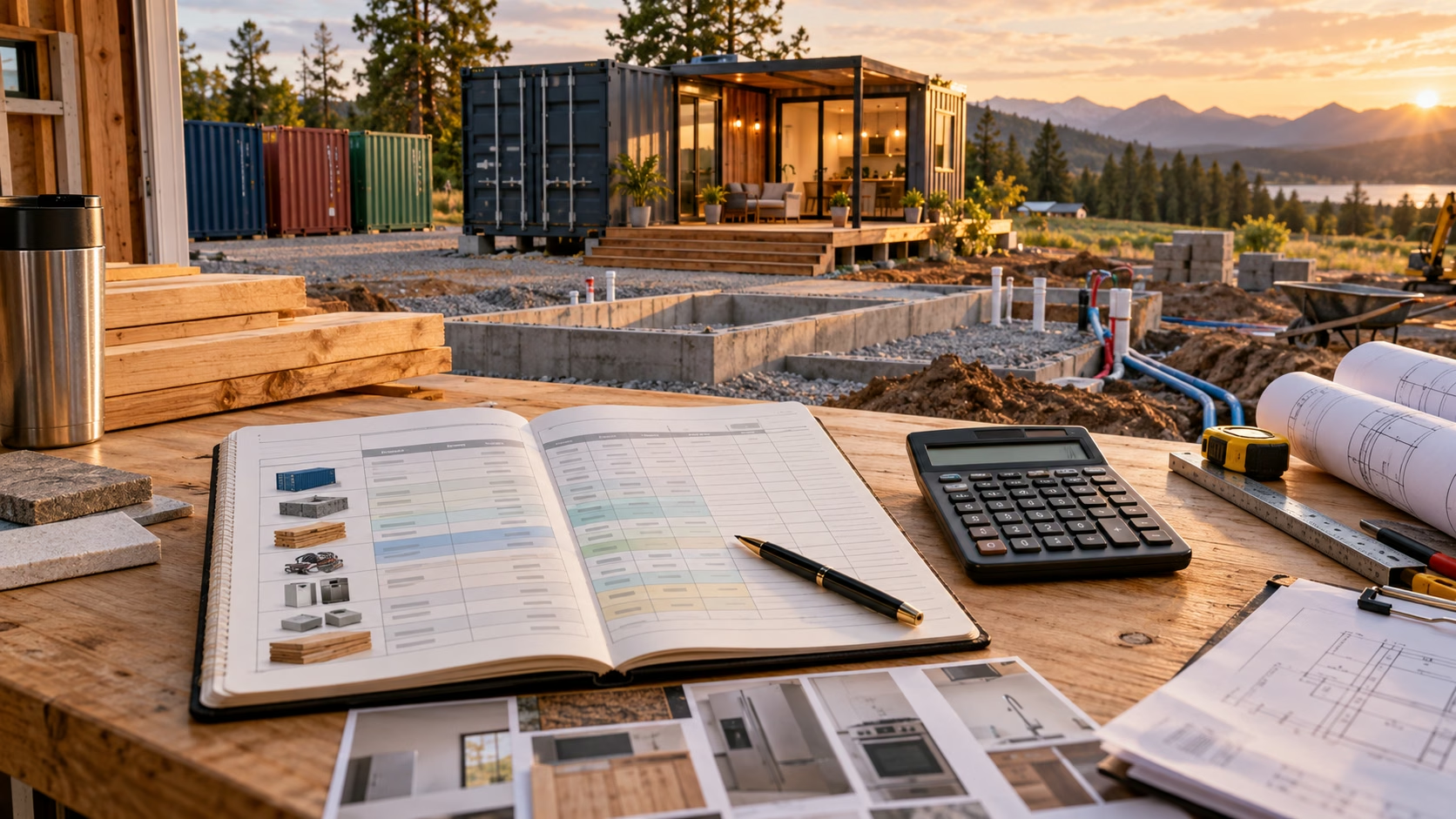
With my shipping container home complete, everybody wants to know how much the whole thing cost me in the end.
Most of this house was built during 2021, the same year everybody was talking about massive inflation in the cost of building materials and construction. Some estimates put the cost of building a house at as much as 25% higher than in prior years. For me personally, a single 2-by-4-by-8 board cost $6.35 when I ordered the lumber for this house in February 2021.
But we will get into all of that.
From the land and shipping containers to the permits, utilities, appliances and final smoke alarms, here is the complete breakdown of what I spent to build my mortgage-free shipping container home on a homestead.
A quick note about these numbers: This was a largely DIY project built from 2019 through 2021. Material prices, container prices, permit fees, land costs, labor costs and site-development expenses vary significantly by project and location. This is my actual cost breakdown, not a universal estimate for every container home.
The final cost: $81,711.95
Let’s start with the final number.
The grand total for my shipping container home was $81,711.95. That includes the land, building permits, three shipping containers, delivery, the well, septic system, foundation, utilities, appliances and the rest of the property improvements.
This is not just the price of the container home itself. It is the cost of the whole property and the complete project.
I believe that number is extremely accurate, probably within about $1,000. There may be a small expense that did not make it into my records, but $81,711.95 is basically it.
The land, design, permits and foundation
The land itself cost me $9,500. After adding closing costs, a survey and other expenses, the total price of the land came to $11,676.
Next came the design of the home. Hiring a structural engineer, an MEP engineer and handling the other design work cost $2,844.76.
The building permits cost $1,455.24.
All three shipping containers, including delivery, cost $6,753. I purchased them in 2019.
Then there were what I like to call the land upgrades. These included things like the well, culvert and electric meter pedestal. Together, those improvements cost $6,976.08.
The foundation for the house cost another $5,000. I had also spent $772 on tools by that stage of the project.
By the time the foundation was finished in the fall of 2020, I had spent approximately $35,400.
|
Early project expense |
Cost |
|
Land, closing costs and survey |
$11,676.00 |
|
Structural, MEP and other design work |
$2,844.76 |
|
Building permits |
$1,455.24 |
|
Three shipping containers and delivery |
$6,753.00 |
|
Well, culvert, electric meter pedestal and other land upgrades |
$6,976.08 |
|
Foundation |
$5,000.00 |
|
Tools purchased by this stage |
$772.00 |
|
Approximate total through fall 2020 |
$35,400.00 |
Setting the containers on the foundation
Once the foundation was ready, I hired a crane operator to lift the containers and set them in place. That cost $875.
At that point, I began cataloging my expenses chronologically, month by month. That gives us a pretty detailed picture of what it took to turn the containers into a finished home.
January 2021: Cutting and welding preparation
In January, I bought scrap steel so I could practice welding. I also spent $27 at Walmart for a spare angle grinder and an extension cord.
This was around the time I started cutting out the walls inside the containers. My 3D model came in extremely handy here. It gave me all the measurements and room dimensions I needed to know where to make the cuts.
The total expenses for January 2021 were $1,040.
February 2021: Lumber, drywall, septic, windows and doors
February was probably one of the most expensive months of the entire build.
This was when I ordered all the lumber and drywall. Together, those materials cost $5,724. The lumber alone cost $4,361.
As I mentioned earlier, I paid $6.35 for each standard 2-by-4-by-8 board. In more normal times, what would one of those boards have cost? Maybe $2 or a little more? I was paying two or possibly three times the normal price.
You can spend all day trying to calculate what the lumber might have cost without the extreme price increases of 2021. Instead of more than $4,300, it might have been $2,000 or perhaps even less. That difference alone could have shaved thousands of dollars off the project.
Between the septic system, lumber, drywall, windows and doors, I spent $15,426.48 in February.
March 2021: Steel and spray foam insulation
In March, I spent $485 on angle iron from a local steel company.
The spray foam insulation cost $3,500. Altogether, my expenses for March 2021 came to $7,611.33.
April 2021: Extra lumber and an I-beam
In April, I spent $195 at The Home Depot on additional lumber. An I-beam and some extra accessories from a local steel company cost another $591.
The total for April was $786.
May 2021: Plumbing
May included a $100 jack-lift rental from The Home Depot and a large plumbing order.
All of the plumbing supplies in that order cost $1,219.88. I also bought an $82 shower valve and a few other items.
The total for May was $1,465.90.
June 2021: Appliances and electrical supplies
June included a major appliance purchase. The refrigerator, oven, microwave, washer, dryer and other appliances cost $3,197.
I also bought a large amount of electrical material. On one visit to Lowe’s alone, I spent $1,145.
My total expenses for June were $5,210.
July 2021: Air conditioning
I bought the air-conditioning unit in July for $2,372.
The total for July was $2,575.
August 2021: Home Depot and Amazon orders
In August, I spent $2,836.91 at The Home Depot and another $825.72 on Amazon.
That brought the total for August to $3,662.63.
September 2021: Exterior decks and steps
In September, I spent $2,664 on the decks, otherwise known as my glorified staircases.
The total for the month was $2,896.
October 2021: Fence, paint and finishing materials
October included $790.82 for the property fence, along with paint, rusty-metal primer, spray cans and other materials from The Home Depot.
The total for October was $4,287.61.
November and December 2021: The last few items
By November, the list was getting much shorter. I spent $234 on Amazon and $150 on closet doors from The Home Depot, for a monthly total of $384.
One of the last things I purchased in December was $92 worth of smoke alarms.
The complete month-by-month shipping container home cost
Here is how the entire project added up:
|
Stage or month |
Cost |
|
Project start through fall 2020 |
$35,400.00 |
|
Crane and container placement |
$875.00 |
|
January 2021 |
$1,040.00 |
|
February 2021 |
$15,426.48 |
|
March 2021 |
$7,611.33 |
|
April 2021 |
$786.00 |
|
May 2021 |
$1,465.90 |
|
June 2021 |
$5,210.00 |
|
July 2021 |
$2,575.00 |
|
August 2021 |
$3,662.63 |
|
September 2021 |
$2,896.00 |
|
October 2021 |
$4,287.61 |
|
November 2021 |
$384.00 |
|
December 2021 |
$92.00 |
|
Grand total |
$81,711.95 |
That is the cost of the shipping container home, the land and the property as a whole: $81,711.95.
What might this home have cost without the 2021 price increases?
Nobody denies that the cost of construction and building materials skyrocketed in 2021.
I paid perhaps three times the normal price for the lumber alone, and lumber was not the only material that went through the roof. At the time, many reports said that the cost to build a home had increased by 20% to 25%.
As a simple thought experiment, if we subtract 20% from my final total, the adjusted cost would be $65,369.56.
That does not change what I actually paid. The real cost was $81,711.95. But in more normal market conditions, perhaps the project might have cost something closer to $65,000. Really, who knows?
Was building a shipping container home worth it?
So, what are my final thoughts? Was the house worth the amount of effort, the amount of time and the final cost?
The answer is ultimately a big, fat yes.
It was an immense amount of work. From the moment the idea came into my head in April 2019 to the end of the build, I spent about half that time doing part-time work to make money on the side. I had a feeling I might run out of money, so I needed to keep generating income while I worked on the house.
I think I could have finished six to eight months sooner, perhaps even faster, if I had not spent so much of that time working other jobs. But I have no regrets about how long it took or the amount of work that went into it.
When you build something like this, you gain invaluable knowledge. I am taking lessons, skills, ideas and insights into the future that I probably never would have gained if I had not built my own house.
I also discovered new passions, including 3D modeling and, specifically, creating shipping container home designs.
The hidden value of building it myself
There are also what I would call hidden valuables.
If anything stops working in this house, it will be much easier for me to understand what is wrong. If there is a leak behind a wall or something suddenly stops working, I know how the house was put together because I was responsible for practically every millimeter of the build.
I probably will not have to call a plumber, electrician or another contractor for many of the things that might go wrong. When it comes to this particular house, I have become the ultimate DIY handyman because I built the entire thing.
That knowledge has real value, even though it does not appear in the cost spreadsheet.
How the cost compares with a conventional home
I spoke with a local builder who had recently sold a 1,500-square-foot house for $298,000. It was on the same size property as mine. The properties in this area are about 1.25 acres.
My container home is 960 square feet, or roughly 500 square feet smaller. If my entire project cost around $81,000 to $82,000 and the property were hypothetically worth even $200,000, that would represent more than $100,000 in potential value above what I spent.
Of course, that is only a hypothetical example. It does not account for every possible selling expense or closing cost, and I did not build this house to sell it.
I built this house because I needed a roof over my head so I could garden, grow food and build a homestead.
That was the whole reason I came out here when the idea first came to me in April 2019. The world has changed a lot since then. Rural living and remote work have become more popular, and the value of rural land in this area has increased tremendously.
The next chapter of the homestead
Now you know the final cost: $81,711.95 for a completed shipping container home on a 1.25-acre homestead, including the land and major property improvements.
The next chapter of the journey is gardening, chickens, goats and the other parts of building a working homestead. That may mean adding a goat shelter, a chicken coop and run, or perhaps a premade shed.
The house is complete, but the homestead is only getting started.
Thinking about a container project of your own?
Every successful container build starts with the right containers and a realistic understanding of the full project. The container purchase is only one part of the budget. Land, delivery, engineering, permits, site work, utilities, insulation and interior construction can all affect the final cost.
Quality Containers can help you find shipping containers suited to your plans and arrange the next steps toward delivery.