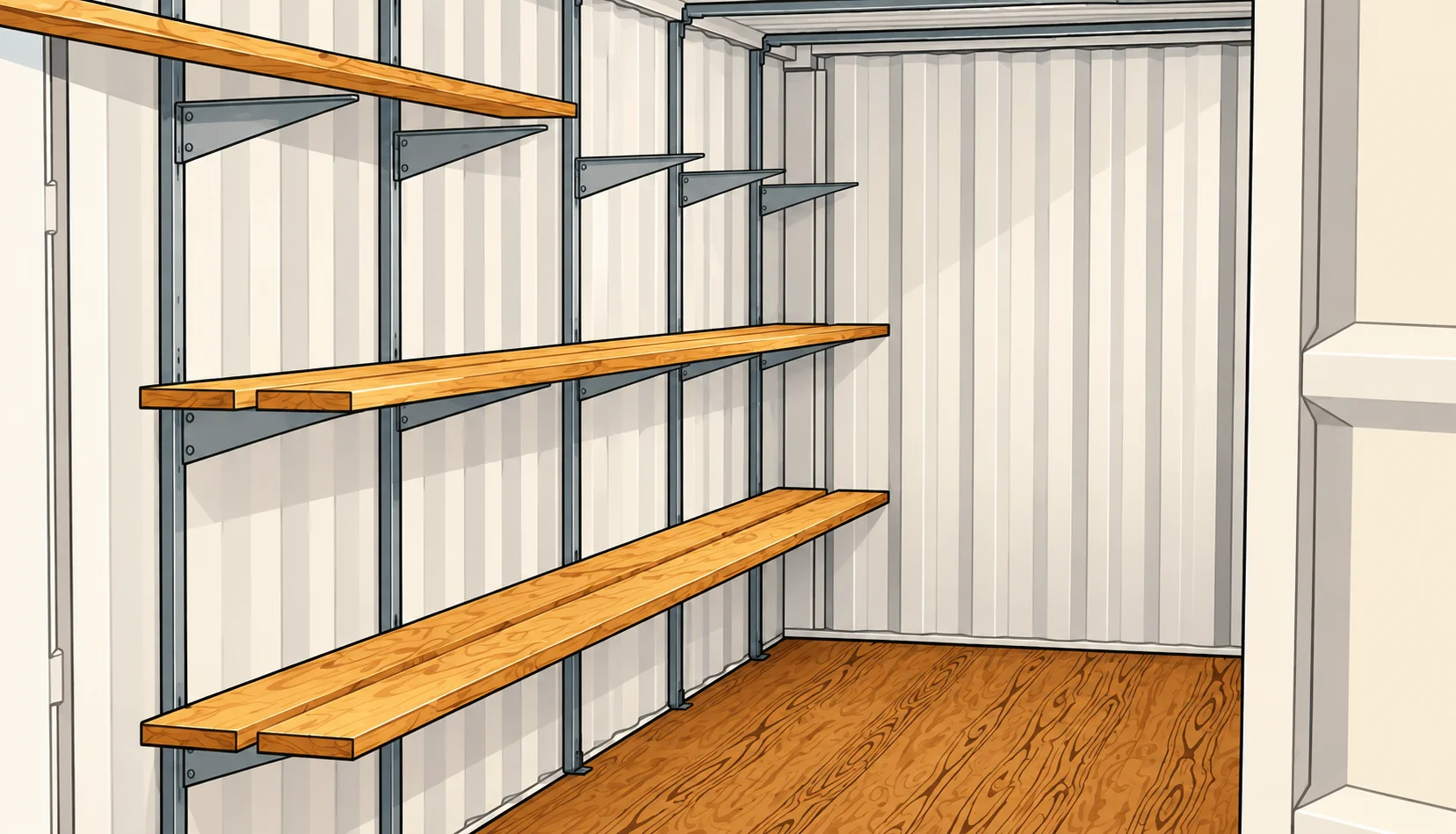
A shipping container gives us plenty of storage space, but stacking everything on the floor makes it harder to find what we need.
Shelving helps us organize tools, supplies and equipment while keeping more floor space available. The first decision is choosing how the shelves will attach and whether we’ll want to change the layout later.
Here are six things we consider when comparing hanging shelf brackets with an adjustable modular system.
1. Hanging brackets offer a simple starting point
For a straightforward setup, we can use compatible shelf brackets that hang from the container’s existing interior rings.
Once the brackets are positioned, we fit the specified lumber into them to create the shelves.
This approach requires fewer installation steps than lining the container with a separate mounting system. It’s useful when we want a fixed storage layout without a more involved interior build.
Before loading the shelves, we confirm the system’s compatibility, installation requirements and load limits, including the attachment points.

2. Fixed shelf heights need planning upfront
The hanging bracket system has shelf levels at predetermined heights.
That makes installation simple, but it limits how we can arrange the space between shelves. We measure the items we intend to store before choosing the system.
Toolboxes, bins and taller equipment may need different clearances. Checking those dimensions first helps us avoid installing shelves that don’t fit our storage needs.
3. A modular system gives us more flexibility
For an adjustable layout, we install a compatible strut-channel system inside the container and attach bolt-on shelf brackets.
The channels provide mounting locations that let us reposition the brackets within the system’s design.
That flexibility is useful when our inventory changes or we want to reorganize the container. We can plan the interior around today’s needs while allowing room for future adjustments.

4. Modular storage can handle more than shelves
A modular mounting system can support different compatible accessories, including shelving brackets and pipe racks.
That lets us organize long materials separately from smaller tools and supplies rather than forcing everything onto the same kind of shelf.
We choose each accessory for its intended use and confirm the load requirements for the complete installation.
The advantage is having a shared mounting system that can accommodate several storage arrangements.
5. Shelving can leave room for larger equipment
We don’t have to fill the container from floor to ceiling with shelves.
By planning storage along the sides and leaving suitable clearance underneath, we may retain space for larger equipment, such as an ATV or snowmobile.
We measure the equipment’s width and height, then check the entrance and the space needed to move it into position.
A useful layout gives us access to the shelves as well as room to park and retrieve the equipment.
6. Choose the system around how often your needs change
The simplest system may be the right choice when we know what we’re storing and expect the layout to stay the same.
A modular system takes more planning and installation, but its adjustability can be valuable for a workshop, changing inventory or a container serving several purposes.
We compare the complete setup, including brackets, shelf materials, mounting components and installation work. That helps us choose based on how we’ll use the container over time.
Make your container easier to use
Good shelving starts with knowing what needs a home: bins, tools, long materials or larger equipment.
At Quality Containers, we help customers explore container options and modification needs. Contact our team to discuss the size and setup that fit your storage plans.