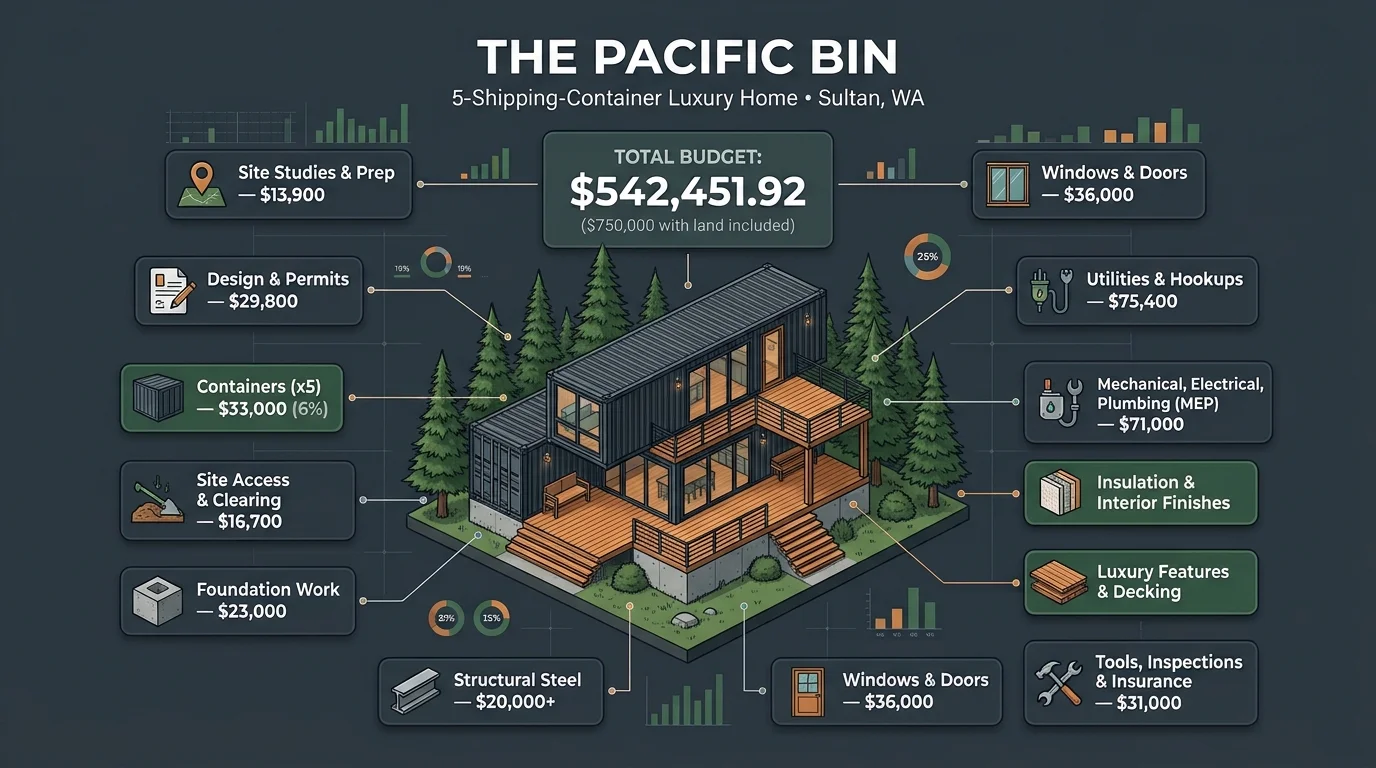
Buying the shipping containers was only a fraction of the cost of building the Pacific Bin.
In the supplied video, the owner breaks down a two-story, approximately 1,600-square-foot container home in Sultan, Washington. Built with five containers, the property includes three bedrooms, one and a half bathrooms and features selected for a luxury vacation rental.
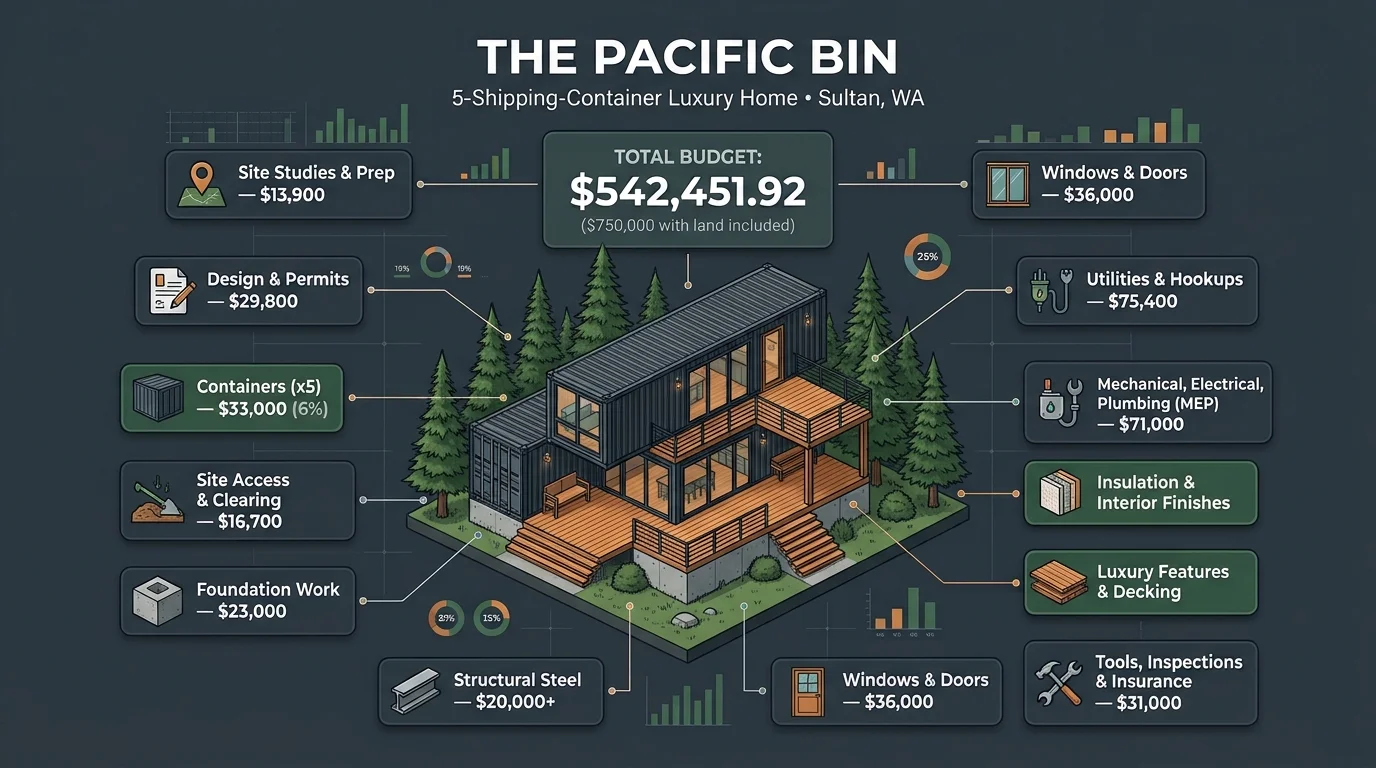
The reported construction total was $542,451.92, with the property bringing the overall investment to approximately $750,000.
These are historical costs reported for this particular project, rather than current quotes or a typical container home budget. Some furnishings were discounted or supplied through collaborations, and friends and family contributed labor.
Here are 12 expense categories that show where the money went and what we can learn when planning our own container build.
 1. Site studies and surveying came before construction
Before building, the owner needed information about the property’s boundaries and environmental constraints.
The reported expenses included:
- Critical-area study: $3,925
- Property survey: $10,000
That’s $13,925 before purchasing construction materials.
We investigate site requirements early so the land budget includes the work needed to establish where and how we can build. Online maps can help with preliminary research, but they don’t replace a required boundary survey.
2. Design and permitting added another substantial expense
The home’s unusual arrangement required architectural plans and structural engineering. Separate drainage and septic design work also formed part of the preparation.
The owner reported:
- Architectural and structural plans: $10,700
- Civil engineering for drainage: $6,180
- Permit and review fees: $9,924.11
- Septic design: $3,000
Together, those reported items totaled $29,804.11.
We account for design and approval costs before setting the construction budget, especially when the layout includes large openings or unconventional stacking.
3. The five containers cost nearly $33,000
The five containers cost just under $33,000, or roughly $6,600 each.
Compared with the reported construction total, the containers themselves represented approximately 6% of the budget.
That’s a useful reminder: the purchase price of the steel boxes tells us very little about the cost of a finished home.
We request project-specific container and delivery quotes, then budget separately for the work needed to convert them.
4. Site access and rental equipment added up
The property needed a roughly 500-foot driveway and preparation for construction equipment.
Reported expenses included:
- Rock for the driveway and foundation preparation: $6,000
- Rental equipment: $7,400
- Asphalt driveway entrance: $3,350
Those items totaled $16,750.
The owner also described working around weekends and days off. We consider scheduling when estimating rentals because equipment costs can continue while the project waits for the next available workday.
5. Water, septic and electrical service were major costs
Preparing the property’s utilities required a significant investment.
The owner reported:
- Well and pumping equipment: approximately $22,000
- Pump house: approximately $2,400
- Electrical service extension and transformer: $27,000
- Septic installation: $24,000
Together, those reported costs were approximately $75,400, separate from the septic design expense.
We investigate utility access before buying land. A property’s purchase price can look attractive while the cost of supplying water, power and wastewater service remains unknown.
6. The foundation cost $23,000
The foundation included perimeter footings and a raised wall supporting the first-floor containers.
The owner reported spending $23,000 and described the generous crawl space as useful for utility installation and future maintenance.
For our own project, we coordinate the foundation with the structural layout, ground conditions and utility routes. The right foundation is specific to the build, rather than determined by the container dimensions alone.
7. Structural steel added more than $20,000
The home’s large windows, overhangs and perpendicular container arrangement required additional reinforcement.
The reported structural steel package cost more than $20,000.
Containers give us a starting structure, but modifications can introduce substantial fabrication work. We establish the reinforcement requirements before assuming an ambitious layout will be inexpensive to build.
A simpler arrangement may have different requirements, but it still needs a design suited to the intended loads and openings.
8. Windows and doors cost $36,000
Large areas of glass helped create the home’s forest-facing appearance, particularly around the main bedroom.
The window and door package cost approximately $36,000. The owner also reported waiting around four and a half months for delivery.
We confirm both price and lead time with the selected supplier before scheduling installation. The glazing package affects the budget, framing details and construction sequence.
9. Electrical, plumbing and HVAC totaled about $71,000
The interior building systems were another major expense:
- Electrical installation: just over $26,000
- Plumbing: approximately $17,000
- HVAC: approximately $28,000
Those reported figures add up to about $71,000.
The HVAC installation included five mini-split indoor units. The owner later questioned what he had paid, which reinforces the value of comparing clearly defined proposals.
We check equipment specifications, installation scope and exclusions before choosing a contractor.
10. Insulation, roofing and finishes added another layer
Making the containers suitable for occupancy required work well beyond the steel shell.
Reported costs included:
- Framing lumber and underlayment: $6,700
- Closed-cell spray foam insulation: $19,500
- Metal roof: $17,650
- Soffits and overhang finishes: $11,500
- Drywall: $11,500
- Interior and exterior paint: $3,100
- Hardwood and tile flooring: $17,000
The project used closed-cell spray foam, but we choose insulation as part of a complete enclosure design suited to the climate and building.
We also budget for roofing and moisture management rather than assuming the existing container roof resolves every weatherproofing detail.
11. Luxury features increased the budget considerably
This project was designed as a high-end vacation rental. Several substantial expenses reflected that goal:
- Hot tub: $17,000
- Decks: approximately $26,000
- Two spiral staircases: approximately $15,000
- Fireplace installation: approximately $6,000
- Live-edge island top and dining table: approximately $9,000
- Countertops: approximately $10,000
- Steam-shower glass door: approximately $2,100
- Furnishings: approximately $14,000
Some furnishings and custom pieces benefited from collaborations, so those amounts don’t necessarily represent what another buyer would pay.
We separate essential construction from optional features early. That makes it easier to decide where to simplify if the budget starts climbing.
12. Tools, consumables and inspections still needed a budget
The owner reported approximately $31,000 for small tools, equipment and assorted build supplies.
That category included items such as drills, nail guns, welding equipment and fasteners.
Other reported expenses included a $432 welding inspection and a $400 blower-door test.
We track these smaller purchases throughout construction. Individually, they may seem minor, but repeated equipment and supply purchases can become a substantial category.
What this build teaches us about container home costs
The Pacific Bin shows how much a container home budget can extend beyond buying the containers.
Site infrastructure, reinforcement, glazing, building systems and luxury features all contributed to this project’s reported total. It also included owner, friend and family labor, so the total isn’t a quote for having another contractor reproduce the home.
At Quality Containers, we help customers explore container options and modification needs. Contact our team to discuss your project, then use those specifications alongside local design, site-work and construction estimates to develop a complete budget.
Based on the owner’s reported historical expenses in “How Much My 2-Story Container Home Cost to Build.” Category figures are rounded where the transcript uses approximate amounts and are not a reconciliation of every expense in the reported total.