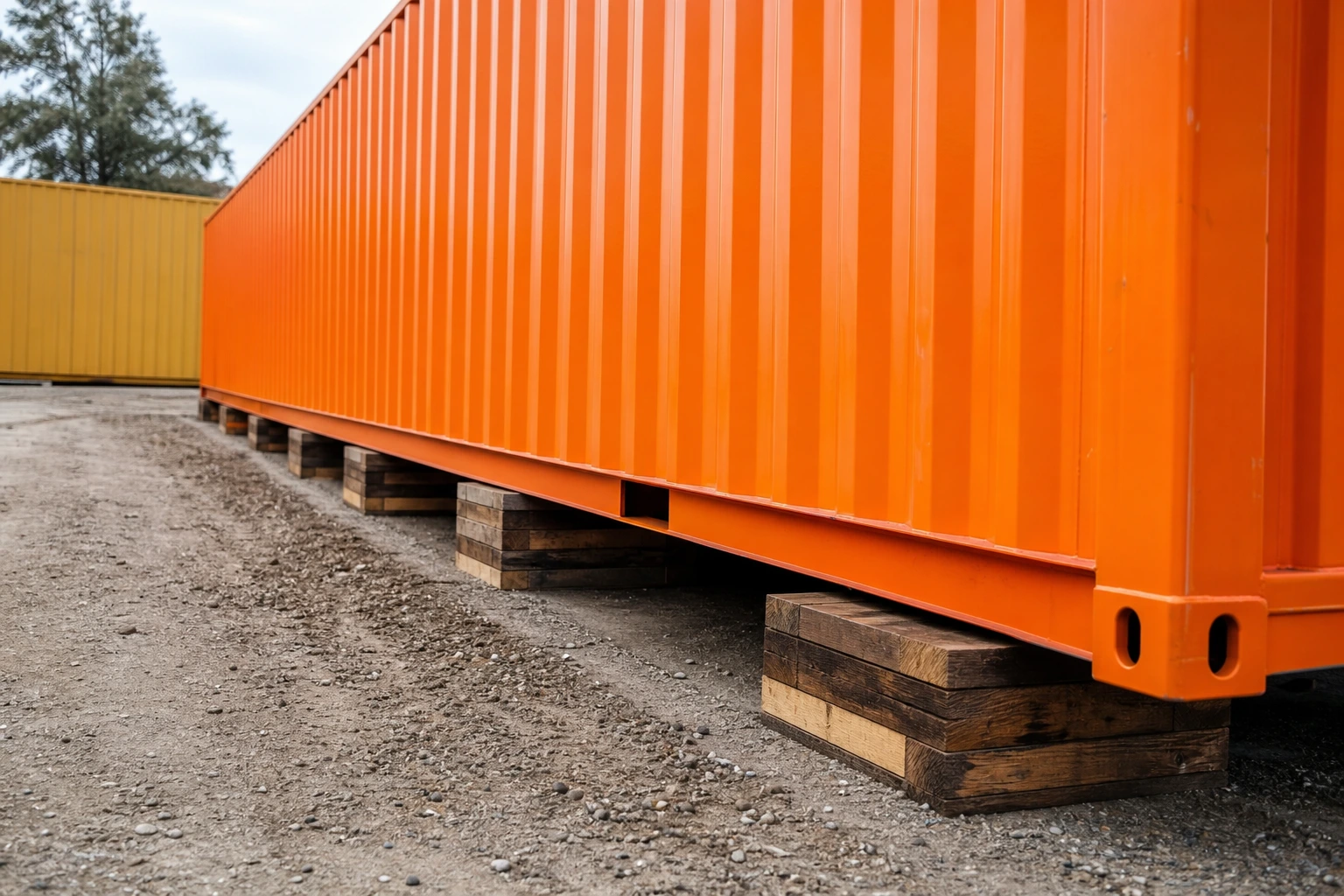
Buying a shipping container is only part of the job. Before it arrives, you need to decide where it will sit and what should go underneath it.
The right answer depends on the site. A container placed on a prepared gravel pad has different support needs than one placed in a field, on soft sandy soil, in an asphalt parking lot, or on a concrete slab. The expected weight inside the container, the local climate, drainage, and how often you plan to use the doors also matter.
Whatever the situation, the basic goals remain the same:
- Keep the container stable.
- Support it at the correct structural points.
- Reduce uneven settlement.
- Maintain airflow beneath the floor.
- Protect the surface under the container.
- Keep the cargo doors operating properly.
- Leave enough access for the delivery equipment.
This guide explains the most common options and the mistakes that can create trouble later.
Why a shipping container should be raised off the ground
Placing a shipping container directly on soil may seem like the simplest option, but it can create long-term moisture and settlement problems.
Air needs to move beneath the container. Without enough clearance, moisture from the ground can collect against the underside and work its way into the wooden floor system. That can contribute to condensation inside the container, sometimes called container rain, and may shorten the life of wooden blocking.
Ground contact also creates a sheltered area where rodents and other pests can live. Raising the container enough to provide visible clearance makes the space less protected and easier to inspect.
The container does not need to be excessively high. Raising it too far can make access inconvenient. A six-inch block beneath a container can create a step of roughly 12 inches once the thickness and height of the container floor are included. If the support itself is 12 inches high, the step into the container may approach 18 inches.
The best height provides adequate airflow without forcing you to build a large ramp or staircase for everyday access.
Support the four corner castings
A standard steel shipping container is designed to transfer loads through its corner posts and corner castings. On a cargo ship, loaded containers are stacked with their corners aligned. The open space between their lower rails is not supported continuously.
That same principle applies when setting a container on land. In most ordinary storage applications, the primary supports should be placed beneath the four corners.
Avoid placing a series of full-width railroad ties or timbers beneath the container at short intervals unless a qualified designer has specified that system. Extra supports beneath the middle can make adjustments harder and may create unintended pressure points if the ground settles unevenly.
Corner blocking is also easier to inspect, jack, and shim later.
Specialized structures, modified containers, permanent buildings, multi-container configurations, and containers with unusually concentrated loads may require an engineered foundation. Corner blocking is a general placement principle, not a substitute for project-specific engineering.
What to use on soil or in a field
Unprepared soil is the most likely surface to settle. Topsoil, sandy ground, silty soil, clay, and recently disturbed earth can all move as moisture and temperature conditions change.
If a container must be placed on soil, increase the footprint beneath each corner. Spreading the load over a wider area reduces the pressure exerted on the ground and can slow settlement.
A basic temporary setup might use a broad base beneath a short, pressure-treated wood block. In the source demonstration, approximately 24-by-24-inch pieces of plywood were suggested as a low-cost way to increase the footprint beneath 6-by-6 blocking.
This is a budget approach, not a permanent foundation. Plywood and wood blocking can absorb moisture, compress, split, and decay. If you use wood, inspect it regularly and expect that it may eventually need replacement.
For better durability, consider properly sized concrete pads, precast footings, or container support pads on compacted material. The appropriate size and depth depend on the soil, container weight, drainage, frost conditions, and local requirements.
Never assume dry ground will remain hard. A full rainy season, freeze-and-thaw cycle, or heavy load inside the container may cause one corner to settle more than the others.
What to use on a compacted gravel pad
A well-built gravel pad is one of the most practical surfaces for a storage container. Gravel drains better than topsoil and can provide a firm, level working area when it is installed and compacted correctly.
The important word is compacted. Freshly spread loose gravel may look level while still being too soft to support the delivery truck or the container. A tilt-bed trailer needs a stable approach. If its wheels sink into newly placed gravel, delivery can become difficult or require towing equipment.
A prepared gravel pad should generally:
- Extend beyond the container footprint.
- Be excavated and built on suitable subgrade.
- Use the appropriate crushed aggregate.
- Be installed in compacted lifts rather than dumped loosely.
- Drain water away from the container.
- Provide a stable path for the delivery vehicle.
Corner pads can be placed on the compacted gravel to distribute the load. Short pressure-treated timbers may also be used to add clearance, but they should be sized and positioned carefully. Remember that every additional inch of blocking increases the step at the cargo doors.
What to use on concrete
A concrete slab provides a strong, clean surface, but a loaded container can still place concentrated pressure beneath its four corner castings.
The bottom of each casting has a relatively small contact area. Setting that small steel surface directly onto concrete can create a high point load, particularly when the container is heavily loaded or will remain in place for a long time.
Container pads can spread that load across a larger area. The pads demonstrated in the source video measured approximately 12 by 12 inches and provided about seven times the bearing area of the bottom of a corner casting.
Before setting a pad down, make sure no loose stones or debris are trapped beneath it. A small rock can create its own pressure point and damage an otherwise smooth slab.
The concrete itself must still be appropriate for the expected load. If you are installing a permanent container building or placing a heavily loaded unit on an existing slab, have the slab and support plan evaluated by a qualified professional.
What to use on asphalt
Asphalt softens when it gets hot. A steel container exposed to the sun can become very warm, while the pavement beneath it is heating at the same time.
Because the lower face of the corner casting sits slightly below the adjoining container rail, the casting may press into softened asphalt. Over time, it can leave a deep impression or even lift and tear the pavement when the container is removed.
Broad support pads beneath the corners spread the weight and reduce this concentrated pressure. This is especially important for rental containers or units that may be moved later.
Choose pads suitable for exterior use and make sure they remain flat and fully supported. Continue to inspect the asphalt during hot weather and after the container has been loaded.
How to place a container on sloped ground
A slightly sloped site does not always need to be buried beneath multiple loads of loose gravel immediately before delivery.
In some situations, a container can be supported with shorter blocking at the high end and taller blocking at the low end. This can keep the cargo-door end close to ground level while creating more airflow beneath the opposite end.
For example, the front may sit approximately five inches above grade while the downhill end sits closer to 12 inches above grade. The exact dimensions depend entirely on the site.
This approach requires stable bearing points and properly stacked supports. Do not create a tall, unstable tower of loose scraps. Significant slopes, erosion hazards, soft soil, and permanent installations require a designed foundation.
Discuss the placement with the delivery company before the truck arrives. The driver needs enough firm, unobstructed space to back in, tilt the trailer, set the container down, and pull away safely.
Do not block the delivery path
One common mistake is carefully arranging full-length timbers or railroad ties before the delivery truck arrives. Customers sometimes place an eight-foot timber across the container width every four feet, expecting the driver to set the container neatly on top.
The problem is that the tilt-bed trailer must travel through that same space. The tires and trailer cannot pass over a row of raised timbers. The driver may have to move all of the carefully positioned supports before unloading.
A better approach is to coordinate with the delivery company. The container can typically be lowered onto the first pair of corner supports, after which the remaining supports can be positioned as the delivery is completed.
Keep the access lane clear and have the approved blocking ready beside the placement area.
Why short corner blocks are easier to maintain
Long timbers can be difficult to adjust after the container settles. Cutting a timber into individual corner supports makes future leveling and shimming much easier.
If one door-side corner drops, you can jack that corner and add a suitable shim without disturbing the entire end of the container. Independent corner supports also make it easier to see which bearing point has moved.
Use durable, broad, stable materials. Avoid narrow stacks that can shift or tip, and never work beneath a raised container without appropriate lifting equipment, cribbing, and safety procedures.
What to do when the doors become hard to open
Cargo doors are often the first indication that a container has settled unevenly. If the doors worked correctly when the container arrived but bind a year later, one or more corners may have moved.
Look at the door alignment, locking rods, frame, and door seals. The wear marks on a seal can help show where the door used to sit and which corner may need adjustment.
The goal is not necessarily to make the container perfectly level according to a spirit level. Containers can become slightly twisted during years of service. A mathematically level container may still have doors that bind.
Instead, adjust the supports until the container is stable and the doors operate smoothly. Shimming may require meaningful thickness, such as a piece of three-quarter-inch plywood or a short section of dimensional lumber. Tiny cabinet or door-frame shims are not designed for this job.
Jacking and shimming a loaded container can be dangerous. Use properly rated equipment on stable ground, keep clear of pinch and collapse zones, and hire an experienced container company when you are uncertain.
Wood blocking versus purpose-made pads
Pressure-treated wood is common because it is affordable, available, and easy to cut. A 6-by-6 timber cut into short sections can work for many temporary storage placements.
Wood also has limitations:
- It can wick moisture.
- Heavy loads can compress and splinter it.
- Ground contact can shorten its service life.
- It may settle into soft soil.
- It requires periodic inspection.
Purpose-made pads or properly designed concrete supports generally last longer and spread loads more predictably. They can be especially helpful on concrete or asphalt, where protecting the finished surface matters.
There is no single support material that is best for every site. The surface, drainage, weight, climate, duration of use, and required access should guide the decision.
Shipping container placement checklist
Before delivery day, confirm the following:
- The placement area is accessible to the delivery truck and trailer.
- Overhead branches, wires, gates, and narrow turns have been addressed.
- The ground and delivery path are firm enough for the truck.
- Water drains away from the planned location.
- Four stable support points are ready for the corner castings.
- The supports provide enough bearing area for the surface below.
- The planned height allows airflow without making the doorway impractical.
- Long timbers or other obstacles are not blocking the trailer’s path.
- The container can be inspected and adjusted if settlement occurs.
- Permanent or modified installations have the required permits and engineering.
The bottom line (or foundation lol)
What you should put under a shipping container depends on what is already under the site.
Soft soil needs a wider, more durable bearing surface. Compacted gravel needs correctly positioned corner supports. Concrete and asphalt benefit from pads that spread the concentrated load of the corner castings. Sloped ground may require different support heights, provided the bearing points remain stable and the delivery route stays accessible.
Most importantly, support the container at its structural corners, preserve airflow beneath it, and plan for future settlement. A little preparation before delivery can prevent moisture problems, damaged pavement, unstable supports, and cargo doors that no longer open correctly.
This article provides general information for storage-container placement. Foundation requirements vary by soil, climate, container loading, modifications, local codes, and intended use. Consult the delivery company and qualified design professionals before installation.
No comment yet, add your voice below!